

The UAE employment visa process typically takes 2 to 4 weeks from job offer to residence stamping — but if you’re counting until your physical Emirates ID card is actually in hand, add another 7 to 14 working days most guides don’t mention. The core sequence: MOHRE work permit (2–5 working days), entry permit (60-day validity), medical fitness test, Emirates ID biometrics, and residence visa stamping.
Mainland Takes Longer Than Free Zone
Mainland companies route through MOHRE and GDRFA, involving more authorities and typically longer queues than free zones, which often run their own streamlined internal approval systems alongside MOHRE. If your offer doesn’t specify which applies, this single question changes your realistic timeline expectation more than any other factor.
The employer pays the full cost of the visa and cannot deduct it from salary, under UAE labour law — fees typically run AED 3,000 to AED 7,000 depending on company category and role classification.
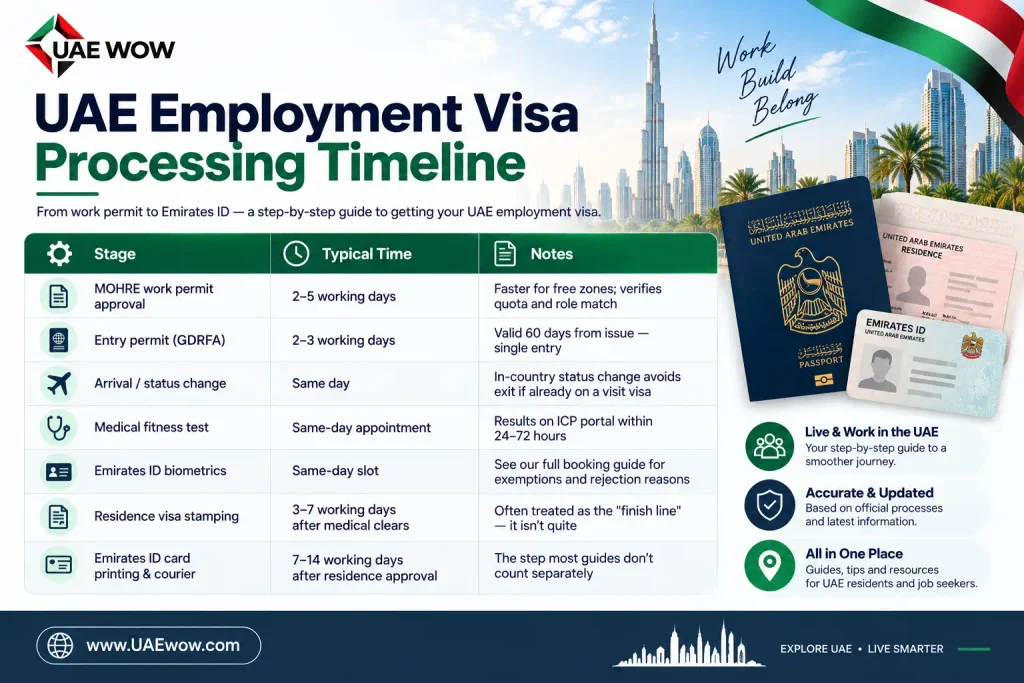
UAE Employment Visa Processing Timeline
| Stage | Typical Time | Notes |
|---|---|---|
| MOHRE work permit approval | 2–5 working days | Faster for free zones; verifies quota and role match |
| Entry permit (GDRFA) | 2–3 working days | Valid 60 days from issue — single entry |
| Arrival / status change | Same day | In-country status change avoids exit if already on a visit visa |
| Medical fitness test | Same-day appointment | Results on ICP portal within 24–72 hours |
| Emirates ID biometrics | Same-day slot | See our full booking guide for exemptions and rejection reasons |
| Residence visa stamping | 3–7 working days after medical clears | Often treated as the “finish line” — it isn’t quite |
| Emirates ID card printing & courier | 7–14 working days after residence approval | The step most guides don’t count separately |
Your employment contract must be bilingual (Arabic and English) and fixed-term — unlimited contracts were abolished under Federal Decree-Law No. 33 of 2021. Any offer letter promising an “unlimited” contract is not compliant with current law.
Emirates ID biometric appointment
The Delay Most Guides Don’t Count
“Residence visa stamping is complete” doesn’t mean your Emirates ID card is in your hand. The physical card still needs to be printed and couriered — typically via Aramex — with an SMS notification sent once it ships, adding 7 to 14 working days on top of the stamping date.
The two most common real-world bottlenecks are medical test queues and Emirates ID biometric slot availability, not the paperwork itself. Booking your biometric appointment the moment you’re eligible, rather than waiting, is the single most effective way to avoid the 60-day entry permit window closing before you finish.
Pro tip: If your entry permit is approaching its 60-day limit and any step is still pending, request a grace extension through GDRFA before it lapses — recovering from an expired entry permit typically means exiting and re-entering on a fresh one, which costs far more time than a timely extension request.
Frequently Asked Questions
How long does the UAE employment visa process take in 2026?
Typically 2 to 4 weeks from job offer to residence visa stamping. If you count until your physical Emirates ID card arrives, add a further 7 to 14 working days for printing and courier delivery.
Does mainland or free zone processing take longer?
Mainland typically takes longer, since it routes through both MOHRE and GDRFA. Free zones often run faster internal approval systems alongside MOHRE, involving fewer separate authorities per application.
What happens if my 60-day entry permit expires before I finish the process?
Request a grace extension through GDRFA if you’re still inside the UAE. Without one, you may need to exit and re-enter on a fresh entry permit, adding real time and cost to the process.
Who pays for the UAE employment visa?
The employer pays the full cost under UAE labour law and cannot deduct it from the employee’s salary. Total fees typically range from AED 3,000 to AED 7,000 depending on company category and role.
Last verified: September 2026
Reviewed by: UAEwow Content Team
Source: Ministry of Human Resources and Emiratisation (MOHRE); Federal Authority for Identity, Citizenship, Customs and Port Security (ICP)
Not legal advice. For company-specific delays or disputes, contact MOHRE directly.
